
Prairie County Court Records After Arrest
A Prairie County jail arrest usually starts with a law-enforcement agency taking the person to the Prairie County Detention Center. The RPS roster can show the booking side: name, mugshot, arresting agency, charge text, bond, court date, and court name. That entry is useful for the first hours after arrest, but it is not the complete court record. The court record becomes more useful after the charging authority files the case and the court indexes it.
The 17th Judicial District Prosecuting Attorney reviews law-enforcement reports and decides what state charges to file. For Prairie County, the official White County prosecutor page lists Rebecca Reed McCoy as the 17th Judicial District Prosecuting Attorney. Once a charge is filed, Search ARCourts may show parties, judge, filings, charge status, future events, judgments, and some public documents. For the jail custody side, use Prairie County jail inmate records. For booking photos, use Prairie County jail mugshots.
Local distinction: roster charge text can be a booking clue, while the filed court charge controls the public case path.
Find Prairie County Arrest Court Records
The official online starting point is Search ARCourts, the Arkansas Judiciary public case-search portal. Arkansas Judiciary explains that Search ARCourts is used for courts on the Contexte case-management system and replaces or reframes the older CourtConnect path. A person can search by participant name, case number, or citation number. Public online data may be limited under Arkansas Supreme Court Administrative Order 19, so the absence of a result does not always mean no case exists.
The Arkansas Judiciary CourtConnect information page explains the public court-search transition and case information access. The screenshot below shows the state court-search context used for Prairie County cases.
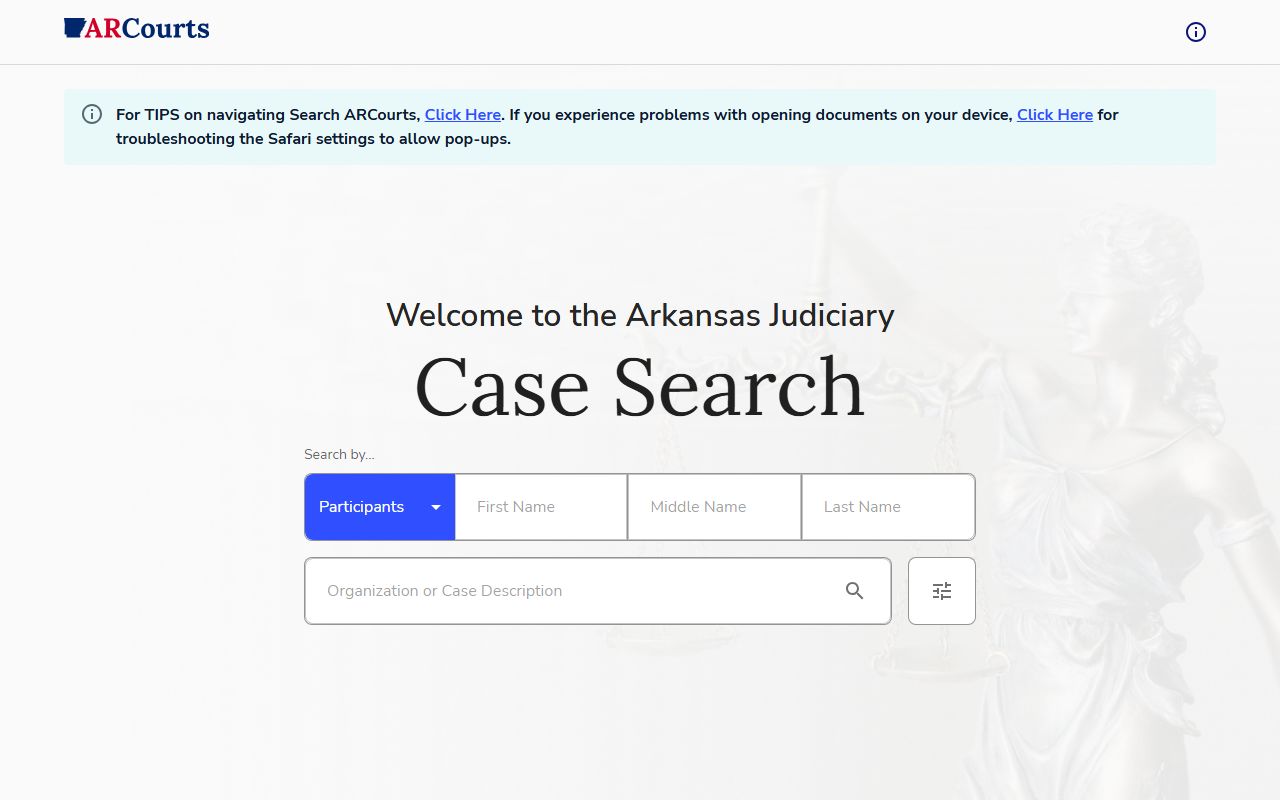
Search ARCourts is not a jail roster. It is the route for filed charges, case events, dispositions, and court documents that are public online.
| Search Field | How It Helps After Arrest |
|---|---|
| First and last name | Best first route when the jail roster does not show a case number. |
| Case number | Direct route if the court, clerk, or a case notice supplied the number. |
| Citation number | Useful for traffic, lower-level, or citation-based matters. |
| County name | Narrows broad name results to Prairie County court records. |
| Court location | Helps separate district, circuit, and local court-location results. |
| Date range | Limits results around the arrest date or first court date. |
| Rows per page | Results can be shown in 25, 50, or 100 row views. |
Prairie County Arrest to Court Workflow
A practical search starts with the jail entry, then moves to court. The RPS roster may show a court name such as Northern Circuit, Southern Circuit, Hazen District Court, or Des Arc District Court. Prairie County District Court, Division 2 is listed by Arkansas Judiciary with Judge Eric Kennedy and departments for Hazen, Biscoe, and DeValls Bluff. That matters because lower-level matters, citations, and early appearances may not follow the same route as felony prosecutions.
- Check the RPS roster for the exact spelling of the name, arrest date, arresting agency, visible charge, bond, and court name.
- Open Search ARCourts and begin with participant search if no case number is known.
- Use advanced filters for Prairie County, court location, case type, date range, or date of birth when results are broad.
- Open matching case results and compare the filed charge, court events, and disposition with the roster clue.
- If no result appears, check later or contact the listed court clerk because a new case may not be indexed yet.
- Request certified copies from the court clerk, not from the jail roster.
For arrest reports, booking sheets, or mugshots, the sheriff or jail custodian is the better records route. For formal case copies, the clerk is the better route. For charging decisions or amended charges, the prosecutor's office may hold records, but those records can be subject to public-record exemptions.
Prairie County Charging Documents
After an arrest, a court case can begin in more than one way. The charging document is important because it turns a booking charge into a court-filed accusation. A booking charge can be broad or temporary. A filed charge can be more precise, amended, reduced, dismissed, or replaced as the case moves through court.
| Document | Who Uses It | What It Means |
|---|---|---|
| Complaint | Officer or prosecutor | A written accusation that can begin a criminal matter, often in lower-court or preliminary stages. |
| Information | Prosecutor | A prosecutor-filed document commonly used to formally charge criminal offenses without a grand-jury indictment. |
| Indictment | Grand jury | A grand-jury charging document that may appear after the jail booking entry. |
| Citation | Law enforcement | A notice or charging document often tied to traffic or lower-level matters. |
The prosecutor's official office page is the best public source for the 17th Judicial District charging office. The 17th Judicial District Prosecuting Attorney page lists the main Searcy office, phone, fax, and weekday hours.

Routine case status is still usually checked through the court portal or clerk. The prosecutor is the charging authority, not the jail roster custodian.
Prairie County Charge Status Terms
Charge status can change more than once after a Prairie County arrest. A person may be booked on one charge, appear in court on a related charge, and later have that charge amended or dismissed. Short labels in a court record matter, but they need plain reading because none of them should be treated as a conviction unless the court record shows a conviction or guilty plea.
| Status | Plain Meaning |
|---|---|
| Pending | The charge or case is open and has not reached a final result. |
| Amended | The prosecutor or court changed the original filed charge. |
| Reduced | The charge was lowered to a lesser offense or class. |
| Dismissed | The court or prosecution ended that charge. |
| Nolle prosequi | The prosecutor declined to continue that charge. |
| Disposition | The final outcome of a charge or case. |
- Booking charge
- A jail entry based on the arrest or hold, useful for quick custody lookup.
- Filed charge
- The charge entered in court by the prosecutor or court process.
- Disposition
- The result of a charge or case, such as conviction, dismissal, or acquittal.
- Detainer
- A hold from another agency, such as ADC, probation/parole, USMS, or another jurisdiction.
Bond Warrants and Prairie County Arrest Records
Prairie County RPS entries can show bond amounts, court dates, and hold language, but the public entry did not show bond type or payment method in the research pass. The sheriff FAQ says a new arrival may call a bondsman or lawyer and one person to say where they are or try to arrange bond. For current bond instructions, the researched local route is to call the Prairie County Detention Center at 870-256-4138.
| Bond or Hold | How to Read It |
|---|---|
| Cash bond | Money is posted directly, usually in the amount required by the court or jail. |
| Surety bond | A licensed bail bond company posts bond under a contract and fee arrangement. |
| Personal recognizance | Release may be based on a promise to appear and court-set conditions. |
| No-bond hold | Money alone will not release the person without court or agency action. |
| Agency detainer | Another agency, such as ADC or USMS, has a custody interest. |
No official Prairie County active-warrant search portal was located. Failure to Appear may show up on the roster after a warrant leads to booking, but that is not the same as a live warrant search. For warrant questions, the researched channels are the sheriff's 24-hour number, the relevant court, Search ARCourts, and a records request to the proper custodian.
Note: A visible bond amount on one roster line does not prove that every hold is bondable or that release is available.
Charges Convictions and Sealed Records
Prairie County court records after arrest should be read with care. A charge is an accusation. A conviction is a final outcome based on a plea, verdict, or finding. A sealed case is a public-access status issue. A sealing or expungement question is handled through court and ACIC materials, not by deleting a jail roster entry by request.
| Issue | Charge | Conviction |
|---|---|---|
| Stage | Accusation after arrest or filing | Final finding or plea resulting in guilt |
| Where checked | Roster clue and Search ARCourts filing | Disposition, judgment, and sentence fields |
| What not to infer | Guilt or final result | Current custody, unless a sentence or hold shows it |
| Issue | Sealed | Expunged |
|---|---|---|
| Public visibility | Hidden or restricted from normal public access by court order | Handled through Arkansas record-clearing terminology and court process |
| Custodian | Court for case record, sheriff for booking display if affected | Court and ACIC materials are the starting point |
| Online result | May not appear in Search ARCourts | May require separate handling by each record custodian |
The Arkansas Crime Information Center criminal-history and sealing forms page is the state source for criminal-history review and petition-to-seal materials.
Prairie County Court Records Access Rules
Arkansas FOIA generally supports inspection and copying of public records by Arkansas citizens during regular business hours unless an exemption applies. The Arkansas Attorney General FOIA Handbook explains request methods and public-records access. Court records, sheriff booking records, prosecutor records, and ADC records are not all held by one office, so the request should go to the custodian that has the record.
Law-enforcement investigative records may be withheld when disclosure would reveal undisclosed investigation materials. Juvenile, sealed, medical, mental-health, and protected court data may also be withheld or redacted. ADC inmate records have separate disclosure rules under Arkansas corrections authority, and DOC search data has its own public-data disclaimer. For a Prairie County arrest, the common split is simple: jail booking records with the sheriff, filed charges with the court, charging decisions with the prosecutor, and state-prison records with Arkansas DOC.
Important: Public case lookup is not an FCRA consumer report and should not be used for employment, tenant, credit, or insurance screening.
Public Record Search
Sponsored Results